
AntiWeak Muscle Breakdown: Trapezius
How the trapezius actually works — and why shrugs aren’t the whole story
Jump to Section:
Ask most people how to build bigger traps, and you’ll hear the same answer:
“Do heavy shrugs.”
It’s one of the oldest pieces of gym advice—and one of the most oversimplified.
The trapezius is one of the largest and most complex muscles in the upper body. Rather than functioning as a single muscle, it consists of multiple regions with different anatomy, different mechanical roles, and different recovery characteristics.
In fact, current biomechanical research suggests that traditional shrugs may effectively train only part of the trapezius, leaving much of the muscle relatively undertrained.
To build the traps intelligently, you need to understand how each region actually works.
This article breaks down the trapezius using anatomy, biomechanics, and current hypertrophy research so you understand the muscle—not just the exercises.
1. Trapezius Anatomy & Function
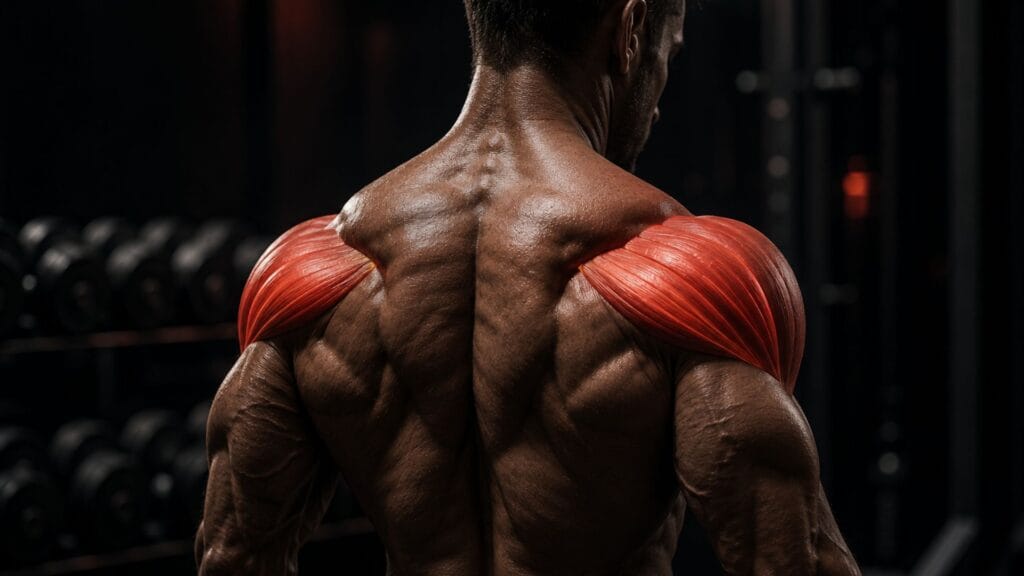
The trapezius is a large superficial back muscle extending from the base of the skull to the lower thoracic spine.
It is commonly divided into three anatomical regions:
- Upper trapezius
- Middle trapezius
- Lower trapezius
Each region has different origins and insertions, allowing them to function largely independently.
Unlike many muscles that primarily move a joint, much of the trapezius’ role is to control and stabilize the scapula.
This alone makes trap training very different from training muscles like the biceps or quadriceps.
Primary Functions
Based on current anatomical evidence:
Upper Trapezius
Primarily contributes to movements involving the clavicle and scapula.
Its exact role in shrugging is less straightforward than many textbooks suggest.
It may also contribute to certain neck movements.
Middle Trapezius
The middle region appears to be the primary contributor to:
- Scapular retraction
- Shoulder elevation (shrugging)
This makes it the region most directly involved during traditional shrug exercises.
Lower Trapezius
The lower trapezius primarily contributes to:
- Scapular retraction
Its commonly described roles in scapular depression and upward rotation remain less certain based on anatomical analysis.
Want to learn how to grow your delts too? ↓
2. Regional Anatomy: Three Regions, Many Subregions
The trapezius is even more complex than its three-region model suggests.
Research indicates that each major region can likely be subdivided into smaller functional subregions.
These subregions differ in:
- internal moment arms,
- muscle activation,
- and potentially recovery characteristics.
Some subregions even appear to change function depending on arm position.
This means the trapezius likely benefits from multiple movement patterns—not because of exercise variety itself, but because different fibers contribute differently under different mechanical conditions.
3. Mechanics of the Trapezius
The trapezius behaves differently from almost every other muscle we’ve covered.
Its primary role often isn’t producing movement.
It’s stabilizing the scapula while other muscles produce movement.
That makes biomechanics considerably more complicated.
Scapular Retraction
Current anatomical evidence suggests that all three major regions contribute to scapular retraction.
This appears to be the single movement that consistently recruits the entire trapezius.
Unlike shrugging, scapular retraction challenges all three regions simultaneously.
This is one of the most important practical findings for hypertrophy training.
Shoulder Shrugging
Shrugs are traditionally viewed as the ultimate trap exercise.
However, anatomical analysis suggests something different.
The middle trapezius appears to be the region best positioned to perform shoulder elevation.
While the trapezius as a whole becomes active during shrugs, much of this activity may reflect stabilization rather than meaningful force production.
This suggests:
Shrugs may be excellent for the middle trapezius—but insufficient as a complete trapezius exercise.
Shoulder Abduction
The contribution of each region changes throughout shoulder abduction.
Between roughly 0–90°, the middle trapezius appears to contribute most.
Above approximately 120°, the lower trapezius becomes increasingly important.
This explains why different overhead positions may alter which trap fibers receive the greatest stimulus.
Neck Movements
Unlike early anatomical assumptions, research suggests the upper trapezius contributes meaningfully to:
- Neck extension
- Lateral flexion
- Axial rotation
Direct neck training may therefore provide a useful hypertrophy stimulus for portions of the upper trapezius.
4. Working Muscle Lengths
One of the most surprising findings concerns muscle length.
Unlike muscles such as:
- hamstrings,
- calves,
- or parts of the deltoids,
the trapezius appears to operate almost entirely on the:
- ascending limb
- plateau region
of the length-tension relationship.
It does not appear to reach the descending limb.
No Stretch-Mediated Hypertrophy
This has an important implication:
The trapezius is unlikely to benefit from stretch-mediated hypertrophy.
Unlike some muscles, loading the traps in increasingly lengthened positions probably does not provide additional hypertrophy through passive tension.
Active Insufficiency
The opposite issue becomes more relevant.
Because the trapezius operates largely at shorter muscle lengths:
Training exclusively with prolonged contractions in the fully shortened position may reduce force production through active insufficiency.
This suggests:
- Dynamic repetitions
- Full, controlled movement
are likely preferable to simply holding heavy shrugs at the top.
5. Neural Characteristics
The trapezius can achieve moderately high voluntary activation, similar to other large upper-body muscles.
However, its fiber type distribution differs substantially between regions.
Upper Trapezius
Contains:
- fewer Type I fibers,
- more Type II fibers,
- and a relatively high proportion of Type IIX fibers.
This makes the upper traps more powerful—but also more susceptible to fatigue and muscle damage.
Middle & Lower Trapezius
These regions contain predominantly Type I fibers.
As a result, they appear more fatigue-resistant and recover more quickly following training.
This regional difference has important implications for programming.
6. Hypertrophy Implications
The trapezius should not be treated as one muscle.
Each region likely responds differently to training.
The Upper Trapezius May Recover Slowest
Because of its higher proportion of fast-twitch fibers, the upper trapezius is likely to recover more slowly than the middle and lower regions.
Heavy shrugging performed too frequently may therefore limit progression.
The Middle & Lower Trapezius Recover Faster
Both regions contain substantially more slow-twitch fibers.
Combined with their shorter working muscle lengths, this likely allows them to tolerate higher training frequencies.
Stability Matters
Much of the trapezius’ role involves stabilizing the scapula.
Exercises that require active scapular control may therefore provide meaningful stimulus even if the traps are not the prime movers.
7. Exercise Selection for Trapezius Growth
Effective trap training should target all three regions – not just shoulder elevation.
Middle Trapezius
Scapular Retraction Movements
→ Horizontal cable rows emphasizing scapular movement
→ Chest-supported rows
→ Horizontal shrugs
These movements recruit all three regions while strongly stimulating the middle traps.
Shrugs
→ Effective for shoulder elevation
→ Primarily emphasize the middle region
→ Should not be the only trap exercise.
Upper Trapezius
Heavy Shrugs
Still useful.
However, because the upper region likely recovers more slowly, excessive shrug volume may be counterproductive.
Direct Neck Work
Neck extension or neck harness work may also stimulate portions of the upper trapezius.
Lower Trapezius
Scapular Retraction With Elevated Arms
Exercises involving scapular retraction with greater shoulder elevation appear to increase lower trap contribution.
Examples include:
- Face pulls with proper scapular movement
- High-angle cable rows
- Prone Y-raises (performed with control)
Learn how to maximize lat growth↓

8. Volume, Frequency & Recovery
Programming should acknowledge that the trapezius is not one uniform muscle.
Upper Trapezius
Frequency
→ Usually:
- 1–2x weekly
Volume
→ Often:
- 4–6 hard weekly sets
Reps
→ Mostly:
- 6–10 reps
Effort
→ Generally:
- 0–2 RIR
Middle Trapezius
Frequency
→ Usually:
- 2–3x weekly
Volume
→ Often:
- 6–10 hard weekly sets
Reps
→ Mostly:
- 6–12 reps
Effort
→ Generally:
- 0–2 RIR
Lower Trapezius
Frequency
→ Usually:
- 2–3x weekly
Volume
→ Often:
- 4–8 hard weekly sets
Reps
→ Mostly:
- 8–12 reps
Effort
→ Generally:
- 0–2 RIR
9. Common Trapezius Training Mistakes
Believing Shrugs Train The Entire Trapezius
They don’t appear to.
Shrugs primarily emphasize the middle region.
Ignoring Scapular Retraction
Scapular retraction appears to recruit all three regions.
For many lifters, it should form the foundation of trap training.
Chasing Stretch
Unlike several other muscles, the trapezius does not appear to benefit from stretch-mediated hypertrophy.
Performing Long Isometric Holds
Heavy pauses at the top of shrugs may not be optimal due to active insufficiency.
Dynamic repetitions are likely more productive.
Treating All Trap Regions The Same
The upper, middle, and lower trapezius differ in anatomy, mechanics, and recovery.
Programming should reflect those differences.
10. AntiWeak’s Perspective on Trapezius Training
At AntiWeak, we don’t view the trapezius as “the shrug muscle.”
We view it as a large, multi-regional stabilizing muscle that requires more than one movement pattern.
We prioritize:
- Scapular retraction
- Intelligent shrugging
- Dynamic movement
- Controlled execution
- Region-specific programming
Rather than endlessly adding heavier shrugs, we focus on applying mechanical tension where each region is best positioned to produce force.
11. Final Thoughts - Understand the Muscle
The trapezius is one of the most misunderstood muscles in strength training.
It is not simply a shrugging muscle.
It is a large, highly regional muscle that:
- stabilizes the scapula,
- contributes differently across movements,
- recovers differently across regions,
- and likely benefits from more than one exercise pattern.
Once you understand how the trapezius actually functions, trap training becomes far more logical.
Instead of asking:
“How heavy should I shrug?”
Ask:
“Which region of the trapezius am I trying to train?”
That question changes everything.