
Plant vs Animal Protein for Muscle Growth
Can plant protein build as much muscle as animal protein? A new meta-analysis gives us answers.
Jump to Section:
Protein is non-negotiable for muscle growth.
But does the source of your protein matter?
For years, the fitness industry has debated whether plant protein is inferior to animal protein for hypertrophy. Some claim plant protein is “incomplete.” Others argue that total intake is all that matters.
A 2025 systematic review and meta-analysis published in Nutrition Reviews examined exactly this question:
Does plant protein build as much muscle as animal protein?
Let’s break down the findings — and more importantly, what they mean for your hypertrophy training.
The Research: What Was Studied?
The paper titled:
“Effect of Plant Versus Animal Protein on Muscle Mass, Strength, Physical Performance, and Sarcopenia: A Systematic Review and Meta-analysis of Randomized Controlled Trials”
(Nutrition Reviews, 2025)
Analyzed multiple randomized controlled trials (RCTs) comparing:
Plant-based protein
Animal-based protein
Outcomes measured included:
Muscle mass
Muscle strength
Physical performance
Sarcopenia-related markers
Importantly:
Protein intake was matched between groups
Diets were isocaloric
Interventions lasted at least 4 weeks
This matters. It removes calorie bias and focuses purely on protein source differences.
Learn how hypertrophy actually works↓

Muscle Mass: Is Animal Protein Superior?
The meta-analysis found a small but statistically significant advantage for animal protein in increasing muscle mass.
Effect size:
Standardized Mean Difference (SMD) ≈ −0.20 favoring animal protein.
What does that mean in practical terms?
It means animal protein produced slightly greater gains in lean mass across studies — but the effect size was modest.
This is not a dramatic difference.
It’s not “plant protein doesn’t work.”
It’s a slight efficiency difference under controlled conditions.
Strength & Performance: Any Real Difference?
Here’s where things get interesting.
When it came to:
Muscle strength
Functional performance
Physical capacity tests
There was no significant difference between plant and animal protein.
That tells us something critical:
The body can adapt and produce strength improvements regardless of protein source — provided total intake is sufficient.
This aligns with broader hypertrophy research showing that mechanical tension and progressive overload are the primary drivers of adaptation — not the food label on your protein source.
Why Protein Quality Matters (Leucine, EAA & DIAAS)
The authors discuss biological differences between protein sources.
Animal proteins generally have:
Higher Digestible Indispensable Amino Acid Scores (DIAAS)
Higher essential amino acid (EAA) content
More leucine per gram
Leucine is particularly important because it triggers muscle protein synthesis (MPS) via mTOR signaling.
If a protein source contains less leucine, you may need:
A higher total dose
A blended source
Or more frequent intake
This doesn’t make plant protein ineffective.
It means dosing becomes more important.
For example:
25 g whey may optimally stimulate MPS
35–40 g of certain plant proteins may be required to match that response
Context matters.
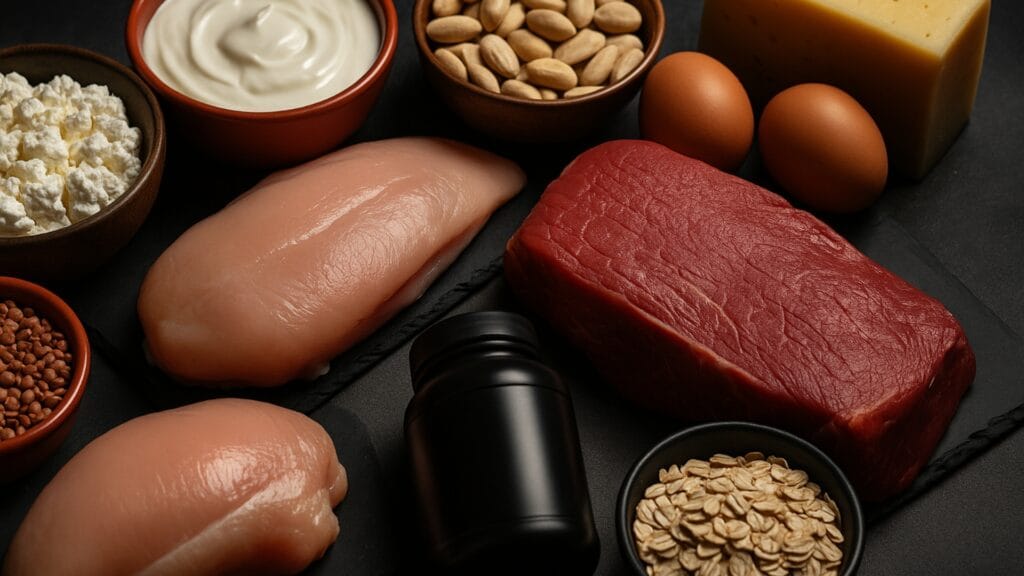
Want to know the top protein-rich foods?↓
Age Differences: Does It Matter More When You’re Young?
The study found the muscle mass difference was more pronounced in adults under 60 years old.
In older adults (≥60), differences were not statistically significant.
Why?
Possible explanations include:
Age-related anabolic resistance
Lower overall responsiveness to protein
Differences in training intensity
In practical terms:
If you are younger and maximizing hypertrophy, protein quality may play a slightly larger role.
But again — total intake and training stimulus remain dominant factors.
Practical Implications for Hypertrophy Training
Let’s translate this into real-world application.
If your goal is maximal hypertrophy:
→ Ensure total daily protein intake of 1.6–2.2 g/kg bodyweight
→ Distribute protein across 3–5 meals
→ Aim for ~0.3–0.5 g/kg per meal
→ Hit a leucine threshold (~2–3 g per meal)
If you use plant protein:
→ Consider higher per-meal dosing
→ Use blended plant sources (e.g., pea + rice)
→ Prioritize total protein consistency
And remember:
Training quality determines the signal. Protein determines whether the signal becomes tissue.
If your programming sucks, optimal protein source becomes irrelevant.
Common Myths About Plant Protein
Myth 1: Plant protein can’t build muscle
False. It can — when dosed properly.
Myth 2: Animal protein is mandatory for hypertrophy
False. It may be slightly more efficient per gram, but it’s not mandatory.
Myth 3: Leucine is all that matters
Oversimplified. Total essential amino acid content and digestion rate also matter.
Myth 4: More protein always equals more muscle
Only up to a point. Excess beyond optimal intake does not accelerate growth.
AntiWeak’s Perspective on Plant vs animal Protein for Muscle Growth
At AntiWeak, we prioritize:
Training stimulus first
Adequate total protein intake
Recovery and sleep
Consistency over dogma
Animal protein appears slightly more efficient for muscle mass gain.
But that difference is small compared to:
Poor sleep
Insufficient training intensity
Lack of good programming
Inconsistent calorie intake
If you prefer animal protein – excellent.
If you prefer plant protein – structure it intelligently.
The real mistake is obsessing over protein type while ignoring training structure.
Hypertrophy is built on:
Mechanical tension
Proximity to failure
Volume management
Recovery capacity
Protein supports the process. It does not replace it.
Final Thoughts – What Actually Matters Most
The 2025 meta-analysis gives us clarity:
✔ Animal protein may have a small advantage for muscle mass
✔ Strength gains are similar between sources
✔ Total protein intake and training quality matter far more
The hypertrophy hierarchy looks like this:
Mechanical tension
Adequate volume
Recovery
Total protein/carb intake
Protein source
If you get the first four wrong, the fifth won’t save you.
Train hard.
Eat enough.
Recover properly.
And let biology do the rest.