
How Many Sets Per Week To Build Muscle? 67 Studies

How Many Sets Do You Need to Build Muscle?
67 studies show where extra sets stop paying off.
Editorial status: Published
Scientifically reviewed: 13. November 2026
Reading time: 8 minutes
Jump to Section:
1. What Did the Study Actually Look At?
2. How Many Sets Per Week Do You Need for Muscle Growth?
3. Is Low Volume Training Enough to Build Muscle?
4. Strength vs Muscle Growth: Why the Strength Curve Plateaus Earlier
5. Does Training Frequency Matter for Muscle Growth?
6. What Counts as a Set for Volume Tracking?
7. How to Apply This: Beginners vs Experienced Lifters
Quick Answer: How Many Weekly Sets Build Muscle?
A 2025 meta-regression of 67 studies and 2,058 participants found that muscle growth rises with weekly set volume, but with strong diminishing returns. About 4 hard sets per muscle per week was the minimum dose for detectable growth. Sets 5-10 were the most efficient range, and the last detectable step needed more than 3 times the volume of the first.
Key takeaways
– More weekly sets produced more hypertrophy on average, but each extra set added less than the one before.
– The minimum effective dose for detectable muscle growth was about 4 weekly sets per muscle.
– The 5-10 set range was the most efficient: roughly 6 extra sets were needed for the next detectable gain.
– Strength gains plateaued much earlier than muscle size, at roughly 4 weekly sets.
– Training frequency had a negligible effect on hypertrophy when weekly sets were equal.
– The authors found no clear plateau for hypertrophy, so high volume is not useless. It is simply expensive.
1. What Did the Study Actually Look At?
The paper is “The Resistance Training Dose Response: Meta-Regressions Exploring the Effects of Weekly Volume and Frequency on Muscle Hypertrophy and Strength Gains” by Pelland, Remmert, Robinson, Hinson and Zourdos, published in the journal Sports Medicine. It is one of the largest analyses of training volume to date and treats volume as a continuous variable instead of splitting studies into arbitrary low and high groups.
Who Was Studied?
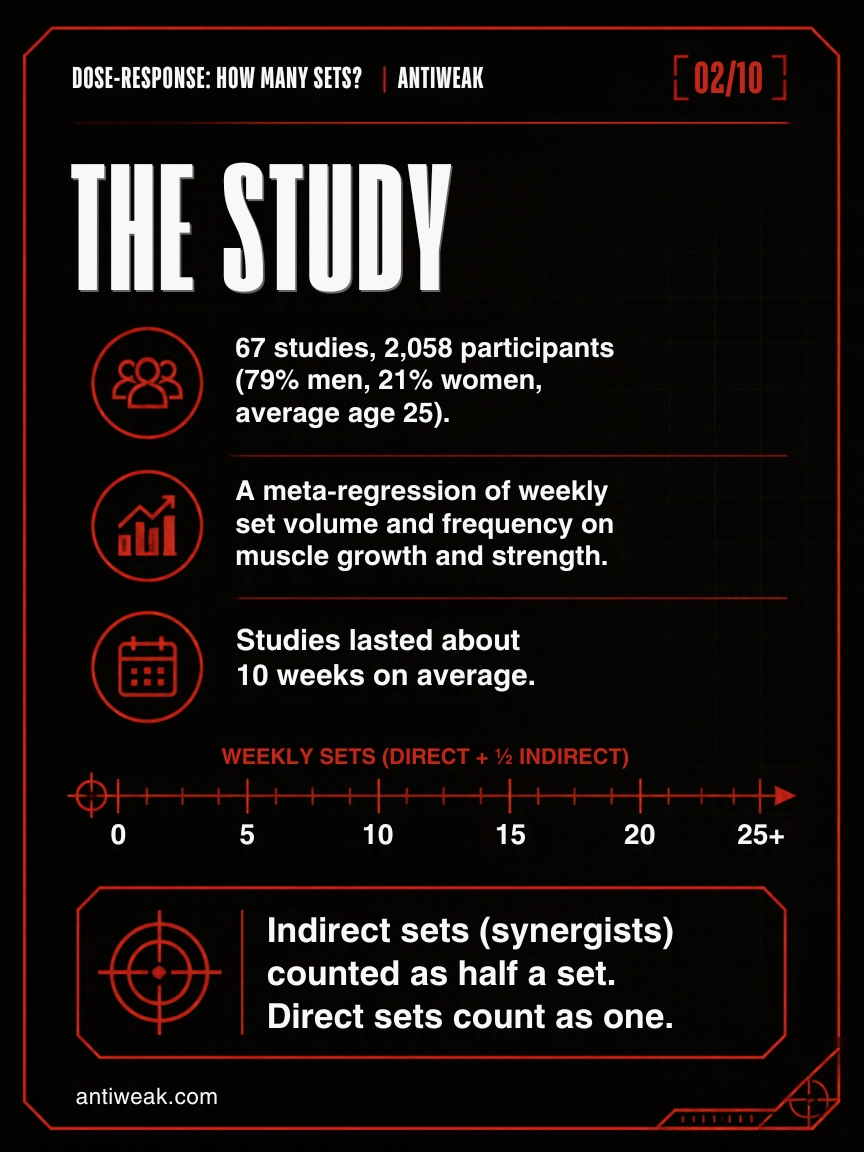
The analysis pooled 67 randomized studies with 2,058 participants. About 79% were men and 21% were women, the average age was about 25 years, and interventions lasted about 10 weeks on average. Twenty-eight studies used untrained participants and 39 used trained participants. Roughly 78% of the measured effects came from protocols that trained to or near failure.
What Is a Fractional Set?
The researchers did not count every set equally. A direct set trains the measured muscle as the main force producer, such as a leg extension for the quadriceps. An indirect set trains it as a helper, such as a bench press for the triceps. In the best-fitting model, a direct set counted as 1 and an indirect set counted as 0.5. This is called the fractional method, and it predicted results better than counting all sets equally.

2. How Many Sets Per Week Do You Need for Muscle Growth?
The Minimum Effective Dose: About 4 Sets
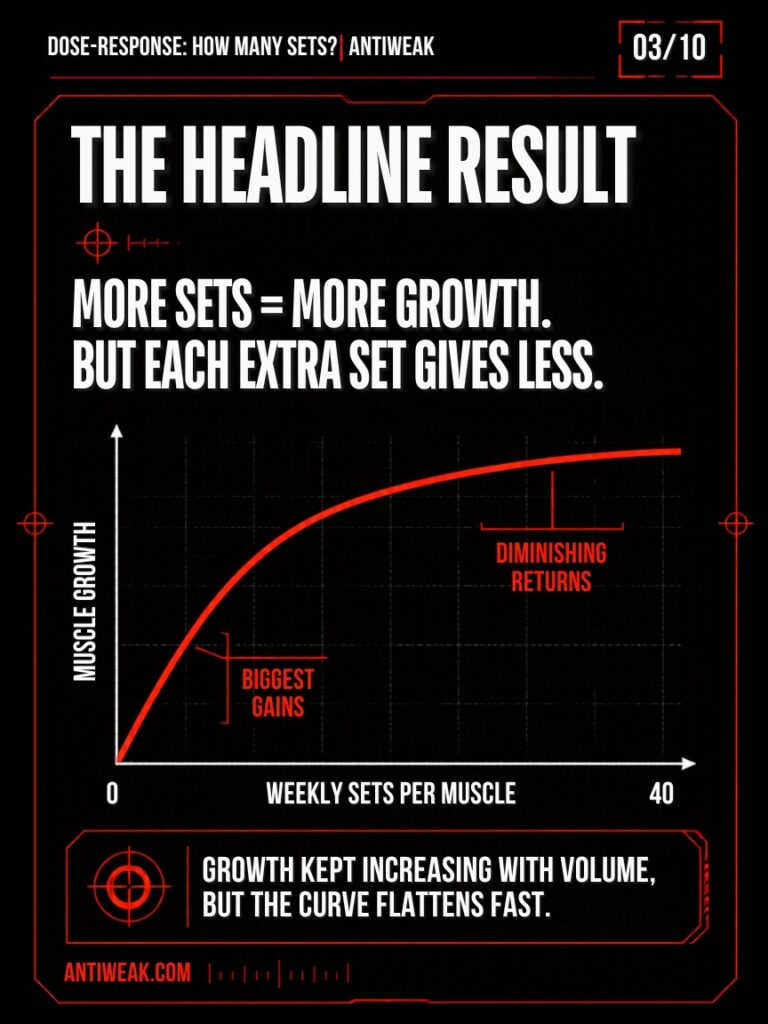
To judge what counts as a real change, the authors used a smallest detectable effect size of 2.05% for muscle size, based on the normal measurement noise in training studies. The model first crossed that line at 4 fractional weekly sets per muscle. That is the minimum effective dose for detectable hypertrophy in this dataset.
This does not mean fewer than 4 sets does nothing. It means growth below that level is too small to separate reliably from measurement error.
The Efficiency Tiers
The authors translated the curve into tiers that show how many extra sets are needed for each further detectable step of growth.
Weekly fractional sets | Efficiency | Extra sets needed for the next detectable gain |
|---|---|---|
4 | Minimum effective dose | Enough for detectable growth |
5-10 | Higher efficiency | About 6 |
11-18 | Intermediate efficiency | About 8.5 |
19-29 | Lower efficiency | About 10.75 |
30-42 | Lowest efficiency | About 12.5 |
43+ | Unclear | Too little data |
Why Diminishing Returns Matter
At the average volume in the studies, each additional weekly set was associated with about 0.24% more muscle size. The best-fitting curve was a square-root shape, meaning returns shrink as volume climbs. The volume needed for the final detectable step was more than three times the volume needed for the first.
In practice, the first sets you do each week buy the most growth per set. Every set after that still counts, but costs more time and recovery for a smaller payoff.
3. Is Low Volume Training Enough to Build Muscle?
Low volume training can build meaningful muscle, and the data show it is the most efficient part of the curve. But the honest reading is more precise than “low volume is as good as high volume.”
What the Data Supports
- A small number of hard weekly sets produces detectable growth.
- The steepest gains per set come from the first 10 or so weekly sets.
- If time, recovery or consistency is limited, low volume is a rational strategy.
What the Data Does Not Claim
- The researchers found no clear plateau for hypertrophy, so higher volumes can still add growth on average.
- Evidence above about 25 weekly sets is thin, so the shape of the curve there is uncertain.
- Average results do not predict every individual. Some people will respond better to more volume.
The practical message is that low volume is a high-efficiency starting point, and you add volume only when your progress asks for it.
4. Strength vs Muscle Growth: Why the Strength Curve Plateaus Earlier
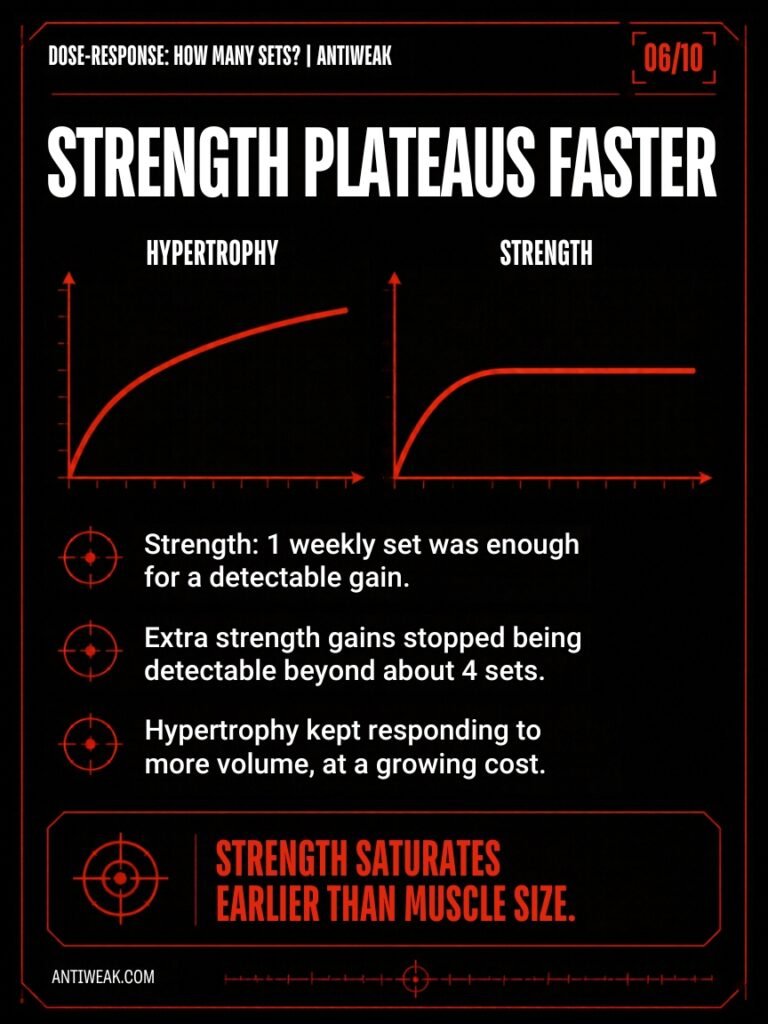
The same analysis modeled strength gains and found a very different curve. One fractional weekly set was enough for a detectable strength gain, and additional detectable gains stopped at about 4 weekly sets. The authors described strong diminishing returns and a functional plateau.
Weekly fractional sets | Strength efficiency |
|---|---|
1 | Minimum effective dose |
2 | About 0.75 extra sets for the next detectable gain |
3-4 | About 2.25 extra sets |
5+ | Additional sets did not consistently add detectable strength |
Why Your Strength Curve Is a Useful Feedback Tool
Early strength gains come largely from learning the lift and neural adaptation. Once those are behind you, strength and muscle size tend to move together, so a rising strength curve on your main lifts is a practical signal that your training is working. It is not a perfect proxy, and researchers still debate how much muscle growth contributes to strength gains. But strength is easy to track every week, while muscle size is not.
It is possible to get stronger without getting bigger in muscle size, but if you get bigger in muscle size, you will definitely get stronger. Therefore, if you have made the neurological adaptations and you are getting stronger still, then chances are that you are getting bigger muscles.
Why Experienced Lifters May Need More Than 4 Sets
Many participants in the studies were performing a strength test they were not used to, so a large part of their quick gains likely reflects learning. That helps explain why 1 set already looked effective.
The paper points to research on well-trained powerlifters, where 1-3 direct weekly sets were not enough for meaningful strength gains, while 3-9 direct weekly sets were. The more trained you are, the less you benefit from learning effects, and the more likely you are to need a higher dose than the pooled average suggests.
5. Does Training Frequency Matter for Muscle Growth?
For muscle size, frequency had a negligible and inconsistent effect once weekly sets were accounted for. The estimated effect was about 0.32% per additional weekly session, with an uncertainty range that included zero. This is consistent with earlier meta-analyses.
For strength, more sessions helped, with diminishing returns. Moving from 1 to 2 weekly sessions raised the estimated strength gain from about 12.7% to about 17.3%, and further sessions added less. A likely reason is more practice with the movement.
If your goal is size, you can spread your sets across the week in whatever way fits your schedule. If your goal is strength, practicing your key lifts at least twice a week is a sound default.
6. What Counts as a Set for Volume Tracking?
Count sets per muscle, not per exercise. Using the paper’s fractional rule as a guide:
- A leg extension counts as a full set for the quadriceps.
- A squat counts as a full set for the vasti and a half set for the rectus femoris.
- A bench press counts as a full set for the chest and a half set for the triceps.
- A row or pulldown counts as a half set for the biceps.
The authors stress that the 0.5 weighting is a heuristic, not a fixed law. Still, it explains why compound lifts let you train several muscles efficiently without doubling your set count.
Also keep in mind that a set only counts if it is hard. Most studies in the analysis trained close to failure, so sets stopped far from failure may deliver less than the numbers here suggest.
7. How to Apply This: Beginners vs Experienced Lifters
The following is a coaching interpretation of the data, not a prescription from the paper.
Beginners
- Aim for about 4-6 hard sets per muscle per week, mostly from compound lifts.
- Train close to failure with good technique and track your reps and loads.
- Expect fast strength gains early, and do not assume they equal muscle growth.
Intermediate and Experienced Lifters
- Work toward the efficient 5-10 set range per muscle per week.
- Use your strength and rep performance on key lifts as a feedback signal.
- Add sets only when progress stalls, and add them gradually.
- Expect to sit toward the upper end of the efficient range as you become more trained.
8. Limitations of the Research
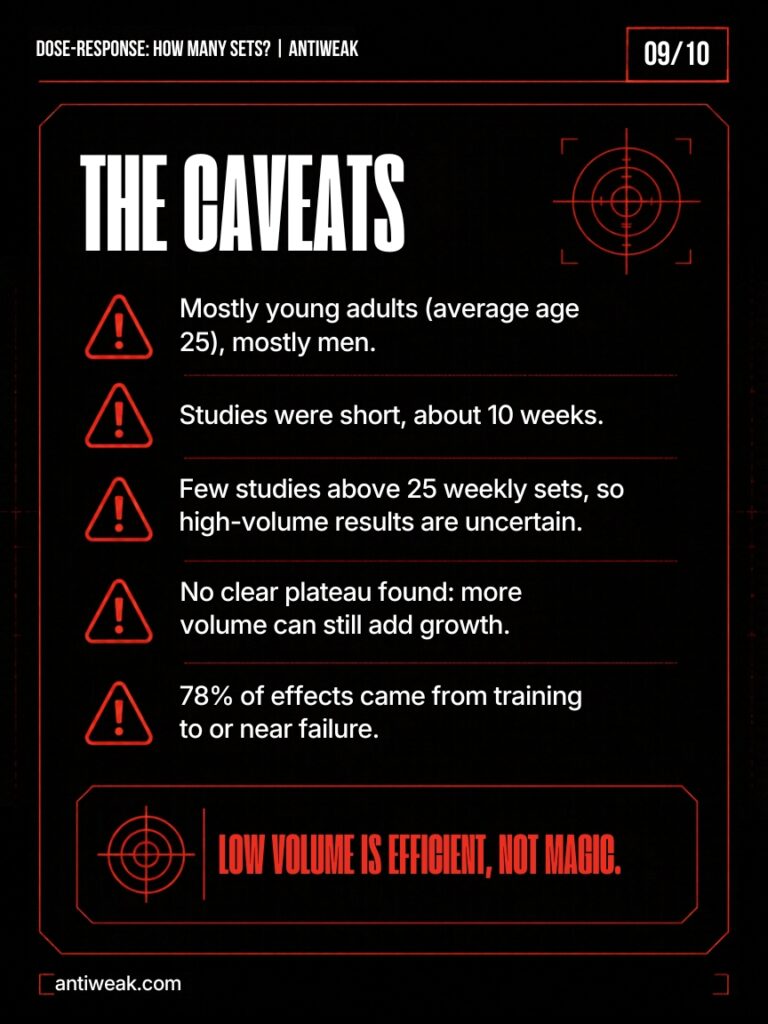
- The participants were mostly young adults, and mostly men.
- Interventions lasted about 10 weeks, which is short for judging long-term adaptation.
- Few studies tested more than about 25 weekly sets, so the high-volume end of the curve is uncertain.
- The models explained only about a quarter of the variance, and several curve shapes remain compatible with the data.
- The analysis looked at site-specific volume, not total-body volume, and did not measure burnout, injury risk or sustainability.
9. Frequently Asked Questions
How many sets per muscle per week should I do to build muscle?
This meta-regression found that about 4 hard weekly sets per muscle is the minimum for detectable growth, and that 5-10 sets is the most efficient range. More sets can add more growth, but at a growing cost per set.
Is 10 sets per week enough for muscle growth?
Ten weekly sets per muscle sits inside the most efficient range in this analysis. It is enough for meaningful growth for most people, and you can add volume later if progress stalls.
Do more sets always build more muscle?
On average, more sets produced more growth, but with strong diminishing returns. The authors found no clear plateau, so higher volume is not useless, but each additional detectable step required progressively more sets.
Is low volume training effective for beginners?
Yes. Beginners respond quickly to a small number of hard sets, and low volume leaves room to recover and stay consistent. Strength gains in particular come early, partly from learning the lift.
Does training frequency matter for hypertrophy?
When weekly sets are equal, frequency had a negligible effect on muscle size in this analysis. It did matter for strength, where training a lift at least twice per week helped.
Why does strength plateau earlier than muscle size?
Early strength gains rely heavily on neural adaptation and skill learning, which saturate quickly. Muscle size kept responding to additional volume for longer, though with diminishing returns.
How hard should the sets be?
Most studies in the analysis trained to or near failure. Sets that stop far from failure may deliver less growth than the numbers here suggest.
10. Conclusion
The best-supported message from this meta-regression is simple: the first few hard sets each week do the most work. Start with at least 4 hard sets per muscle, aim for the efficient 5-10 set range, train close to failure, and use your strength progress as feedback. Add volume only when progress stalls. Diminishing returns are not zero returns, but they are a strong reason to stop chasing more sets for their own sake.